Your month starts on your payday, not on the 1st. You write what you plan to spend in each category, then one line each time money comes in, goes out or moves between your accounts: cash, bank, OPay, Moniepoint, M-Pesa, MoMo. Month shows what’s left in each category and, for food, transport and data, how much that leaves per day until your next payday.
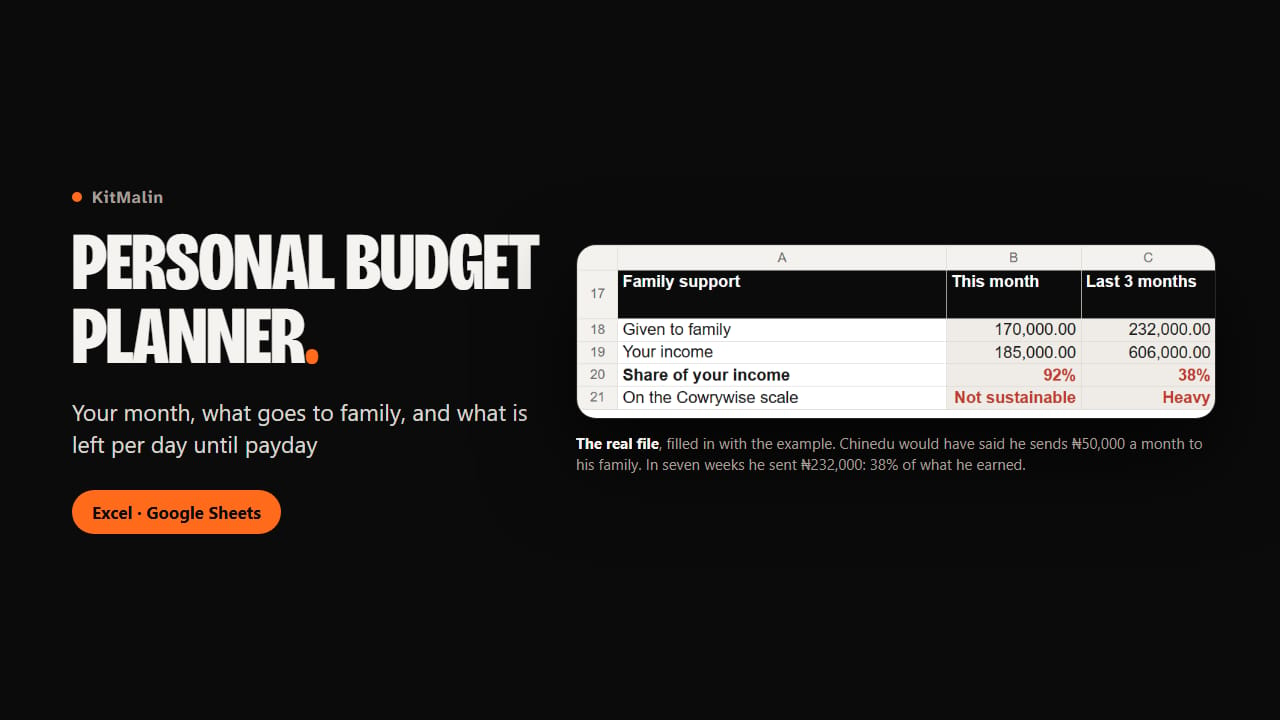
Family support has two categories: what you send every month, and one-off requests like school fees, a hospital bill or a burial levy. Month divides the total by your income, for this month and the last three, and puts it on a scale taken from a Cowrywise report quoted by Nairametrics. The scale is a guide, not a rule. In the example file, Chinedu, a made-up phone repairer in Lagos, would have said he sends ₦50,000 a month. In seven weeks he sent ₦232,000: 38% of what he earned.
Savings and loans are not spending. Money you put into your ajo, PiggyVest or an emergency fund counts as savings, and your ajo payout comes back as savings, not as income. A loan to a cousin or from a friend has its due date, and turns Overdue when the date has passed.
Each savings goal takes the price today and how fast you think it will rise. The file works out what it will cost on the target date and how much to put aside each month. In the example, a ₦480,000 laptop costs about ₦520,800 by June at 15% a year, so ₦10,000 a month is far from enough.
If your income changes from week to week, let it all land in one account and pay yourself the same salary on payday. Month shows how many months of salary that reserve can still pay.
A Fee column keeps the bank and mobile money charges, like the ₦50 stamp duty a sender pays in Nigeria on each transfer of ₦10,000 or more. Your accounts carry over from one month to the next: Month shows what each one held on payday and what it holds now.
Rename a category and your old lines keep counting. Clear one you don’t need and nothing breaks. A line with something missing says what to fix, next to it.
You get the empty file, the example file with figures that add up, and a guide with pictures taken from that example. We opened the example in Google Sheets: its figures match our tests. The file is also built for Excel 2016 or later, using only functions both have, but we haven’t opened it in Excel ourselves yet. Any currency.
What you get
- Personal Budget Planner.xlsx: the empty file, for your own money
- Personal Budget Planner (example).xlsx: the same file filled in for a made-up phone repairer in Lagos, with figures that add up
- Start here.pdf: the guide, with real pictures of the example file
- In the file: Settings (payday, accounts, reserve), Categories, Transactions, Month, Savings goals, Loans and debts