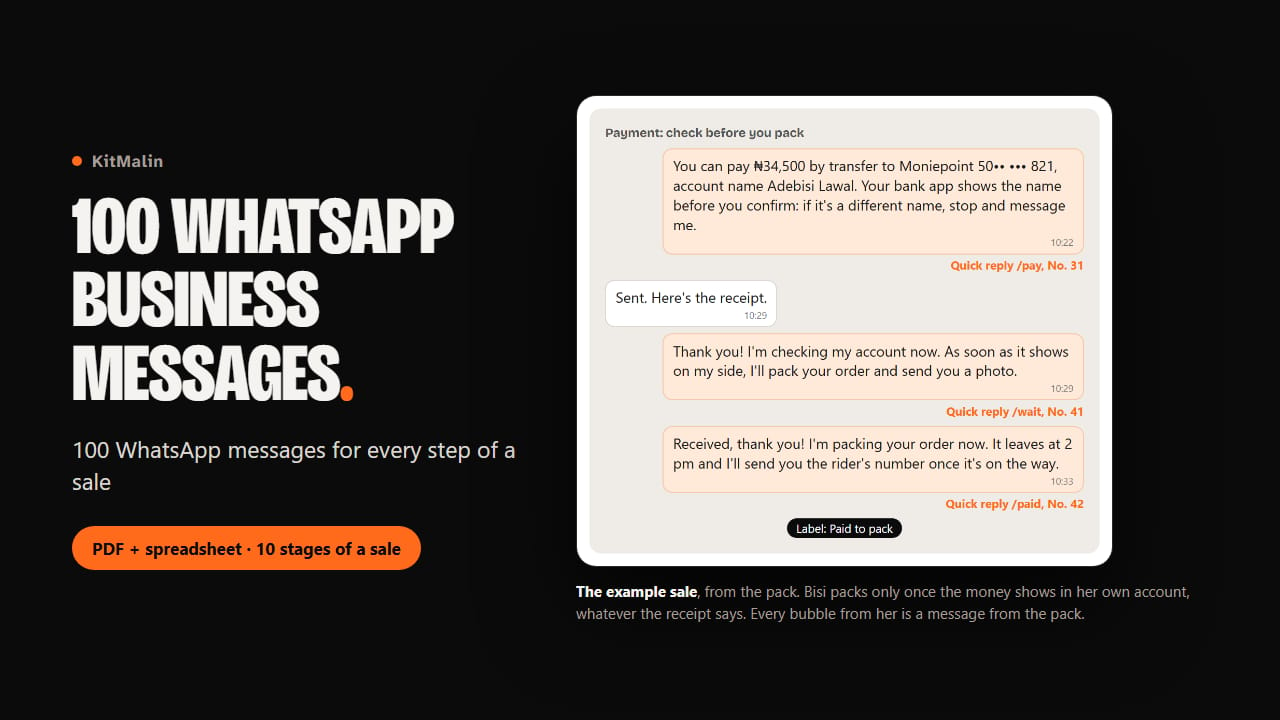
A customer types "HM?" under your post. Another says she has paid and shows you a receipt, but nothing has arrived. A third wants pay on delivery, then isn’t home when the rider gets there. This pack has a message for each of those moments, and for the ones around them.
Two of the 100, exactly as they are in the pack:
No. 43, the customer shows a receipt but nothing has arrived
"Thanks. I’ve checked and nothing has arrived in my account yet. I send orders once the money shows on my side; it’s the same rule for every customer. Can you check with your bank that it went through?"
When to use it: "A fake alert or receipt can be made with an app in seconds. Stay polite: real transfers get delayed too. Don’t hand over anything until your own balance shows it."
No. 37, no pay on delivery, offering a middle way
"For [AREA], I can’t do pay on delivery, because the rider charges me even when an order is refused. You can pay just the delivery fee now ([FEE]) and the rest at the door, or pay at pickup."
When to use it: "A flat no loses careful buyers. Give a middle way: delivery fee first, a deposit, or payment at pickup. Don’t treat the customer as a scammer for asking."
Every message comes with a note like these: when to send it, when not to, and the money rule behind it.
The 100 messages follow a sale in 10 stages: first questions, price and delivery, confirming the order, payment, checking the money, packed, sent and delivered, after the sale, reviews and photos, coming back to buy, and away messages. Each one also has a short version of 25 words or fewer. 25 messages can be sent as they are. The others have up to 3 blanks in square brackets to fill in, like the price or the area.
Payment details come in a version for bank transfer in Nigeria, for M-Pesa Till, Paybill and Pochi la Biashara in Kenya, and for MoMo in Ghana. No message accepts a screenshot as proof of payment: they tell the customer, politely, that the order leaves once the money shows in your own app. Money sent back only ever goes to the account that paid, which is how you avoid the "I paid too much, send me the difference" trick.
The setup pages show how to save 30 of the messages as quick replies with short shortcuts (/price, /pay, /del, /loc, /legit...), how to follow each order with 6 labels, and how the automatic messages really work: the greeting only goes out on a first message or after 14 days without one, and the away message only while your phone is online. These rules come from WhatsApp’s own help pages, read in November 2026. We haven’t set them up on a Nigerian, Ghanaian or Kenyan number ourselves, and the guide says so.
There’s also a full example sale: Bisi, a made-up ankara seller in Lekki, sells a two-piece and a headwrap to a customer in Ajah for ₦34,500, from the first message to the review, with the messages of the pack.
The messages are written from Nigerian and Kenyan customers’ messages. For Ghana, the MoMo payment message and the fake "pending" trick are there; the rest is plain English to adapt to how your customers write. There are no pidgin or sheng versions: we had no native speaker to check them, and it’s better that you change a few words yourself than send something that sounds fake.
What you get
- Start here.pdf: read it first. In 6 pages, it sets up WhatsApp Business (quick replies, labels, greeting and away messages), with 4 things never to do with payments and what to know before you switch on Meta’s AI agent
- 100 WhatsApp Business Messages.xlsx: copy your messages from here. The Message column comes first, the Stage column filters by moment of the sale, and the Quick replies and Labels tabs list what to save in WhatsApp
- 100 WhatsApp Business Messages.pdf: for reading the 100 messages stage by stage, each with its short version and its "When" note, plus the example sale