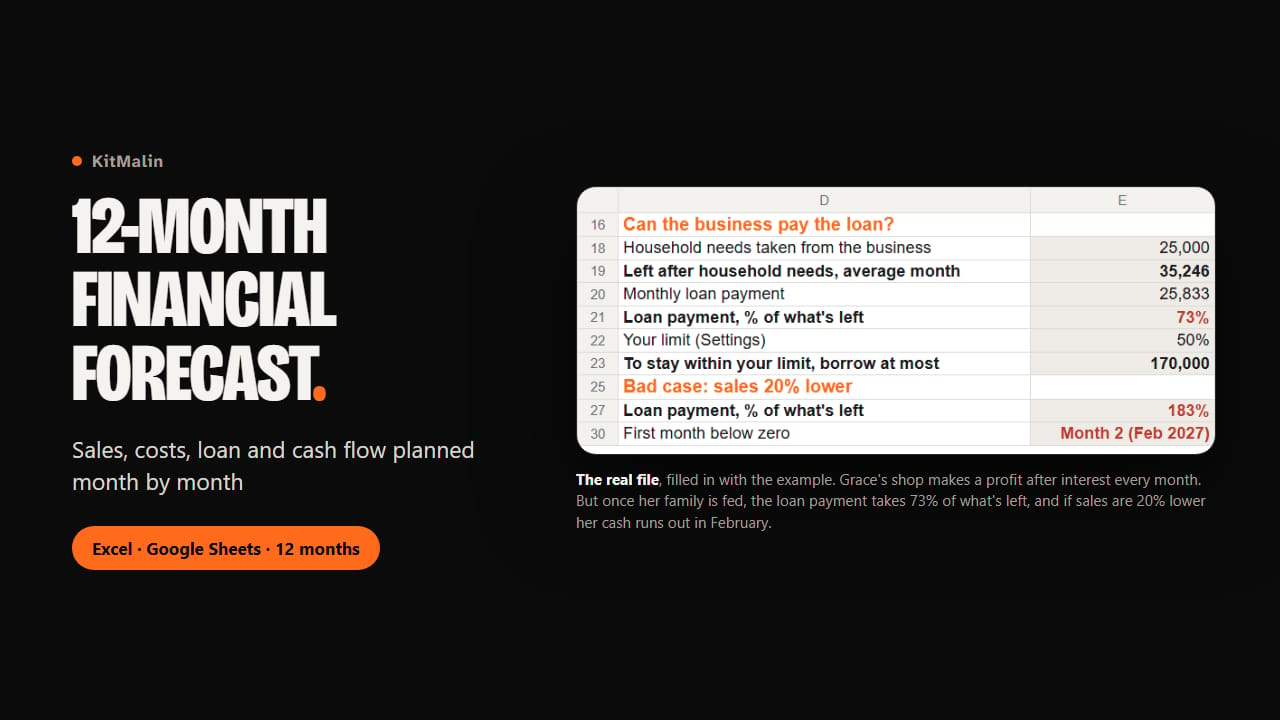
Most forecasts stop at profit. A loan officer goes further. From your monthly profit, they take out what your household needs, then look at how much of what’s left the loan payment would take. MicroSave’s toolkit for microfinance credit managers puts the acceptable share somewhere between a quarter and three quarters, depending on the lender.
This file does the same sums before you go. You type what you need before you open, what you sell in a normal month, your monthly costs, what your household takes from the business, and the loan exactly as your lender offers it: the amount, the rate a month or a year, flat or on a reducing balance, the number of payments, a grace period, the fees. The 12-month plan then works out your profit after loan interest, the share of what’s left that the payment takes, your cash at the end of each month, and the same plan with sales 20% lower.
In the example file, Grace wants KES 250,000 to open a beauty shop in Kisumu. On paper, the shop makes a profit after interest from the first month. But once her family’s KES 25,000 a month is paid, the loan payment takes 73% of what’s left, and if sales are 20% lower her cash runs out in February. On those terms, the largest loan that fits her limit is about KES 170,000. The file never tells you to borrow more: when the payment is too heavy, a larger loan only makes it heavier.
It also shows what a flat rate really costs. Grace’s 2% a month, flat, comes to KES 60,000 of interest. The same 2% on a reducing balance would cost about KES 33,680.
The money you keep in reserve to run the first weeks stays in your cash on opening day, instead of being counted as spending. Stock is paid for before it’s sold, and rent or a yearly permit paid upfront is paid before you open but still counted month by month in your profit.
You get the empty file, an example file filled in for Grace (a made-up example, with figures that add up), and a guide with pictures of each step taken from that example. Summary and the 12-month plan each fit on one A4 page when you print them.
We opened the example in Google Sheets: its figures match our tests. The file is also built for Excel 2016 or later, using only functions both have, but we haven’t opened it in Excel ourselves yet. The empty file starts in naira (NGN); pick GHS, KES or any other currency in Settings. The example is in Kenyan shillings because Grace lives in Kisumu: the sums work the same in any currency.
What you get
- 12-Month Financial Forecast.xlsx: the empty file, for your own plan
- 12-Month Financial Forecast (example).xlsx: the same file filled in for a made-up beauty shop in Kisumu, Kenya, with a loan that turns out too heavy
- Start here.pdf: a guide with real pictures of the file, what a loan officer checks, and who asks for a forecast and who doesn’t
- In the file: Settings, Start-up, Sales and Costs sheets, a 12-Month Plan with a bad case, a one-page Summary, and a Loan sheet with the interest and capital of each payment, to compare with your lender’s schedule