You take orders on Instagram or WhatsApp and send them out with riders. By evening, the same questions come back: which rider still has cash, how much you owe him, which transfer you haven’t seen in your app yet, and who still owes you.
This file answers them. The Orders sheet follows your day. When a customer confirms, you fill the first columns: name, date, phone, items, price, zone, how she pays. In the evening, you add the rider, the status, the day it was delivered and the money that came in. The customer’s name and "Where it stands" stay on screen while you scroll, which matters on a phone.
The delivery fee and the total fill in from your zones, and you can type another price for a free delivery, a far address or a waybill to another city. When your prices go up, you add the new price with the day it starts: older orders keep the old one.
An order shows Done only when the money is really with you: a transfer you have seen in your own app, or the rider’s cash in your hand. Until then, the line says what’s missing: Check in app, Cash with rider, or To collect.
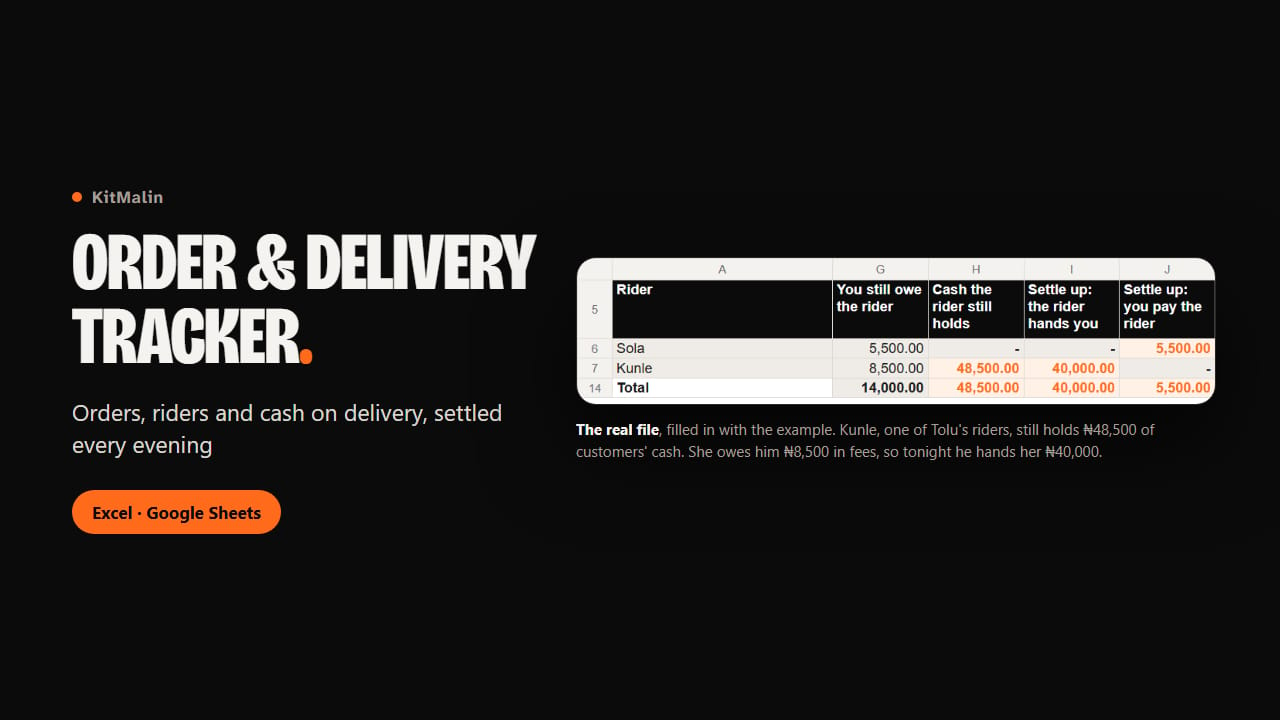
The Dashboard gives each rider’s balance: fees earned, what you have paid him, the cash he still holds, and the amount that settles everything today. In the example file, Kunle holds ₦48,500 of customers’ cash and is owed ₦8,500 in fees, so he hands over ₦40,000. If a rider already holds some of your money on your first day, one line sets it.
A cancellation before dispatch costs nothing. A refusal at the door costs the rider’s trip there and back, so the file counts the two apart. Refusals are also counted by phone number, however it’s typed: 08035550134 and +234 803 555 0134, copied from WhatsApp, are the same customer. A customer who refused before comes up in red when she orders again. Month by month, you see what delivery really costs you once refused trips and free deliveries are counted. In the example, one refused trip to Lekki turns November’s delivery into a ₦5,000 loss.
You get the empty file, an example file filled in for Tolu, a made-up perfume oil seller in Surulere, Lagos, with figures that add up, and a guide with pictures of each step taken from that example.
We opened the example in Google Sheets on a computer: its figures match our tests. It is also built for Excel 2016 or later, using only functions both have, but we haven’t opened it in Excel ourselves yet. Any currency.
What you get
- Order & Delivery Tracker.xlsx: the empty file, ready for 1,000 orders
- Order & Delivery Tracker (example).xlsx: the same file filled in for a made-up perfume oil seller in Lagos, with 16 orders and 2 riders
- Start here.pdf: a guide with real pictures of the file, one step at a time
- In the file: your riders and dated zone prices, an Orders sheet with drop-down lists and a "Fix" message on incomplete lines, a Rider pay sheet, and a Dashboard with each rider’s balance, the orders not finished and each month’s delivery figures