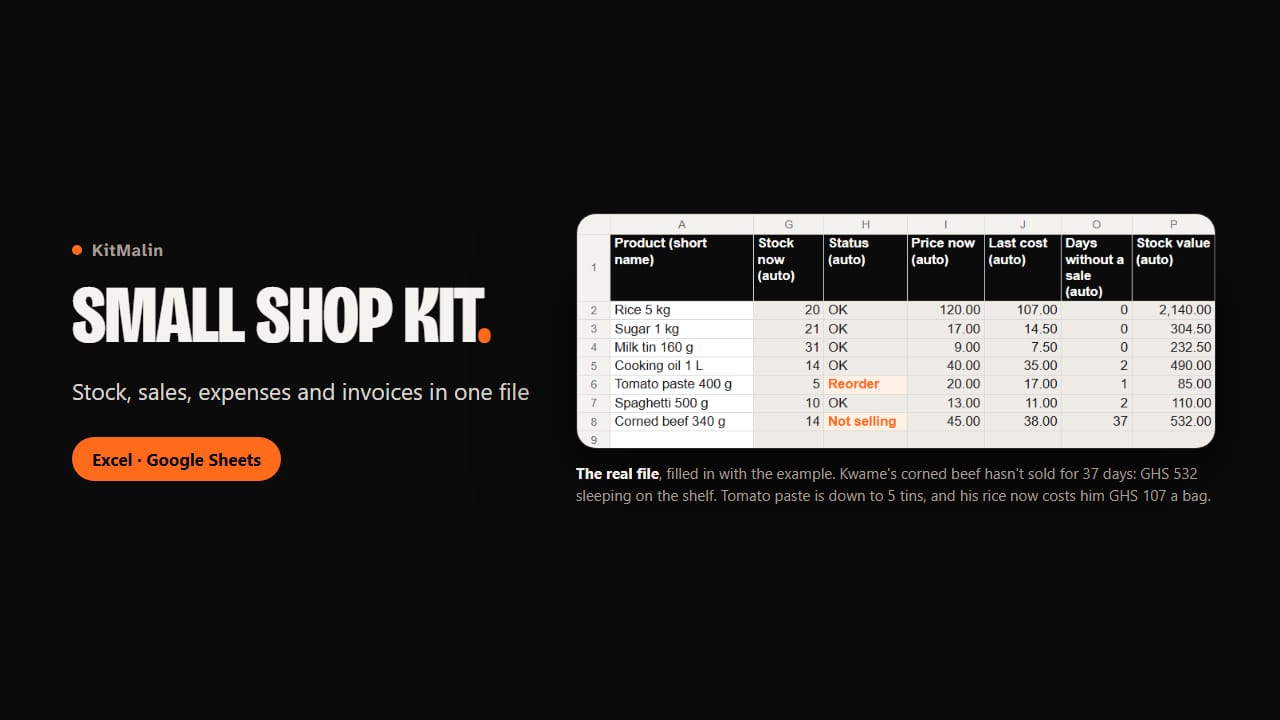
Every day you only type in 2 sheets: Sales and Who owes me. The others are for once a week or once a month, and the dashboard shows your month whenever you want.
In a lot of shop spreadsheets, including the first version of this one, changing a price changes every old sale too. In this file, each sale keeps the price and the cost it had on its day. When your supplier raises his price, you type your new selling price on the restock line, and only the sales after it use the new figures.
You type your products once, then each restock, with the transport to bring it, and each sale. The file keeps your stock, tells you what to reorder, and shows the products that haven’t sold for 30 days, with the money sitting on the shelf.
A customer who pays later gets a line with what they paid now, what they still owe and the day they promised. Who owes me adds it up for each customer and shows who is late. When they pay, you add one line. On your first day, you copy your credit notebook into Who owes me, with what each customer owes and the day they promised, without inventing a sale.
The dashboard shows the month’s profit: sales, the cost of what you sold, expenses and stock lost (from your stock counts). Then it takes off what you took for yourself, in money and in goods. If you took out more than the shop made, it tells you.
From any sale, the Invoice sheet makes a numbered invoice with what was paid, the balance, the due date and your bank and mobile money details. Save it as PDF on a computer and send it on WhatsApp. The invoice number follows the row of the sale, so the numbers have gaps.
You get the empty file, an example file filled in for Kwame, a made-up provisions seller in Bantama, Kumasi, with figures that add up, and a guide with pictures of each step taken from that example. The file is made for Excel 2016 or later and only uses functions that Google Sheets also has. We opened the example in Google Sheets on a computer and its dashboard showed exactly our figures; we haven’t opened it in Excel ourselves yet. Any currency works (GHS, NGN, KES or another one, one per file).
What you get
- Small Shop Kit.xlsx: the empty file, for your own shop
- Small Shop Kit (example).xlsx: the same file filled in for a made-up provisions shop in Kumasi, from 1 to 12 November 2026
- Start here.pdf: a guide with a real picture of the file for each step
- In the file: Products, Purchases, Sales, Expenses, Who owes me, Stock count, Asked for (what customers ask for and you don’t sell), an Invoice made from your sales, and a monthly Dashboard
- A "Fix" message in red next to any line that is incomplete, and drop-down lists for products, payment methods and expense categories
- Room for 1,000 sales lines, 300 restocks, 300 expenses and 200 products